
This gallery contains 18 photos.
Quick little interview I did over at Roadie Notes. Kind of a news flash: I like talking about writing (and myself). Go fuckin’ figure. Enjoy your weekend, gang.


This gallery contains 18 photos.
Quick little interview I did over at Roadie Notes. Kind of a news flash: I like talking about writing (and myself). Go fuckin’ figure. Enjoy your weekend, gang.
So 2016 was kind of a shitshow for all involved. Icons died, morons voted (and, yes, they were cataclysmically stupid, for a variety of reasons) and the band Twenty-One Pilots had a number of hit singles. There was very little for people to look at in 2016, nod in a satisfied way, and say, “That’ll do, pig. That’ll do.”
Still, for others–like, um, me–2016 wasn’t…all that bad, actually.
Let’s break it down:
I had seven original pieces published:
I also sold two other stories:
Oh, yeah, and I had my first book published – Bones Are Made to be Broken, which collected 14 of what I thought were my best works from the past five years. Michael Bailey edited and kept me in line, Pat R. Steiner rocked the fuck out of the illustrations, and Damien Angelica Walters (one of my favorite writers and people I’m lucky enough to call friend) did me the solid of rocking out an epic foreword.
In the month that it’s been out (it only came out on the 29th, which feels much longer ago than it actually is), the book has gotten better reviews than I could’ve hoped for (even one this morning, hyperlinked in the word “for”) even landing on placement on some notable lists, which leaves me absolutely dumbstruck. My editor has sent copies to the juries of various awards–the Bram Stokers and the Shirley Jackson Awards, among others–and that’s all cool (and it is, though I’m a pessimist enough not to be overly excited or confident on my little book’s chances), but, for me, it’s the oddity of old school friends messaging me to talk to me about the book, people who haven’t seen me in almost twenty years, knew me only when I went by my last name and was more than a little nihilistic (well, more nihilistic than I am now, anyway). I hope people like it. Fuck, I hope people buy it, so I can continue to justify doing this every night.
On that last note, go here.
So, what does 2017 have in store?
Well, I was invited to submit to three anthologies, one of which I need to get with another writer to talk about.
The hardcover to Bones will be released in standard Dark Regions Press fashion (signed by me, Pat, Damien, and Michael; leather-bound; color illustrations; a slipcase), but also expanded by me to include another story (“Grownups” from the tribute anthology Widowmakers) and story notes on everything.
“How I Became a Cryptid…” should see the light of day, which I’m excited about; it’s a weird left-turn for me and a fuck of a fun write, anyway. I can’t wait for people to read it.
I also have two essays written for Richard Chizmar’s Stephen King read-a-thon, whenever he gets to those books (he’s been a little busy himself, recently).
I might be guest-editing something again, which is nice.
And whatever the hell else I happen to write and–hopefully–sell. I have some shit percolating that might work out. Hopefully.
And that’s that.
Thanks for stopping by.

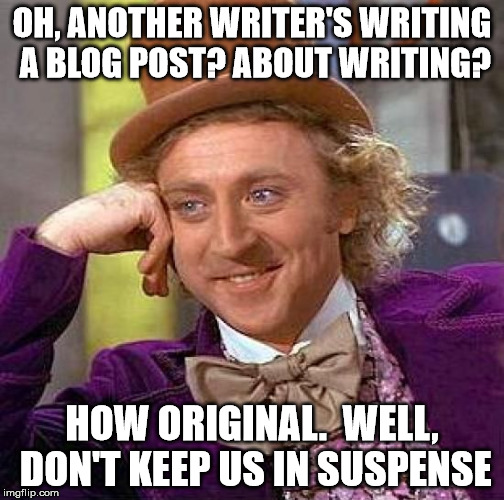
Let’s just get the Wonka out of the way…
So, last week, I did a quickie-bit on suspense over at This Is Horror (with about a dozen other writers, so it, y’know, WASN’T ALL ABOUT ME–though, that’d be cool to do sometime [hint]). Each of us was asked what we thought was most important in creating a sense of suspense of a story or a scene and we duly supplied our answers. I’m not lying that it took me 20+ attempts to get the goddamned thing right; I didn’t write out my thing, just made a list of bullet points to cover, and let fly. This works for me in the classroom, where I have students to bounce ideas off of and modify my presentation to fit the situation, but this style’s a lot fucking harder when I’m staring at a computer mic and pressing RECORD. I’d get three-fourths of the way through my spiel, stumble like I’d suddenly put a sack of marbles in my mouth, and there went your ball game. My wife came in at one point–I recorded in our guest bedroom, to escape any excess ambient noise (re: the dogs)–and asked, “Wasn’t it supposed to be only 5 minutes long?”
But, in the end, I got something in the can and Michael David Wilson didn’t hate it, and, hopefully, listeners didn’t, either. I’ve listened to the entire broadcast a few times now and some people were much more prepared than I was. It’s kinda amazing we all didn’t contradict each other–although John Skipp and I ran in similar directions for a moment–because there’s nothing more confusing than a methodology to writing. The only truths that seem to exist for all people is, “You start a story, you finish the story.” Everything else is dictated by the whims, needs, and talent-quotient of the individual writer.
(Also, it was a fun mental game to finally hear the voices of some people I’ve corresponded with–like Stephanie M. Wytovich, Kristi DeMeester, John Skipp–but had never spoken audibly to. But that may just be me.)
Anyway, I wanted to pause and talk about suspense in a little more detail. I had 5 minutes on TIH, which got the basic thrust of what I wanted to do across, but, after finishing, I realized that I really liked talking about it.
Apologies ahead of time.
So, suspense, if we can all get on the same page here, is the building of dread–of knowing that the worst is yet to come, that the other shoe is about to drop. It’s the doctor holding the biopsy report when he comes into the room, but not immediately saying anything. It’s the phone ringing late at night for a parent whose child is still not home. It’s the walk down the hall to the boss’s office after being unexpectedly summoned. It relies on a fairly negative view of the world–the biopsy is the Big C, the caller is the local police saying there’s been an accident, the unexpected summons is to discuss the consequences of dismal 4th Quarter profit projections–but humans, in our ability to see multiple outcomes, tend to go darker.
If you’re into horror, the possibility of “the worst is yet to come” becomes more of a probability–but not always. That’s the dread, the gamble you take when you go to the next paragraph or the next page.
(Pause. If you flip the negative view, you get anticipation, not suspense. The Wedding Day. The night before Christmas. The labor process at the end of a really healthy pregnancy. It may be tinged with fear [will she ditch me at the altar? will Santa think I was bad? will there be complications?], but when you see the end positively, there’s no sense of dread. End pause.)
With that concept of suspense in mind, you branch off into two formats: what I call the literary equivalent of a knock-knock joke and more of a long-form strategy.
The knock-knock joke style of suspense is familiar to anyone, like me, who cut their teeth on the slasher films of the 1980s–I’m talking Friday the 13th, Halloween, Nightmare on Elm Street, Sleepaway Camp, etc. For example, you have this group of horny, clueless teenagers traipsing around the abandoned summer camp that has a shady history, looking for a place to hump and listen on the soundtrack some song that sounds like a B-side to a bigger hit during the summer of ’87, and you hear the rustling of leaves out in the dark, the snapping of branches, the tumble of a small pile of rocks. You, as an audience member, know the (supernatural?) killer is eventually going to stop fucking around and gut those teenagers like trout, and, when he/it does, that’s the punchline. You then go back to our regularly scheduled program–which is, commonly, a survivor girl.
When you employ a long-game strategy, everything becomes suspenseful. That plotmap you zoned through back in English class, the rising action prior to the climax, ratchets up, and you find yourself on the edge of your seat, or flipping pages in a blur, barely able to keep your eyes on the current line because, goddammit, you have to know what happens next to your protagonist and antagonist.
What’s the difference between the two?
Empathy. The ability for the reader or viewer to identify or relate with the fictional character presented to them.
With knock-knock joke suspense, there’s little empathy. The teens dawdling through the creepy woods are the equivalent of walking blood-bags, and you’re drumming your fingers, waiting for the killer to just open them up. These characters were created to die, and so we build no connection to them. (You can see it in each slasher series as the number next to the title grew–viewers found themselves rooting for the villain, which says all kinds of unseemly shit about the audience.) Sure, there can be a kind of visceral reaction, but that has more to do with the creator’s presentation of the event–short, sharp sentences, or, in the case with film, a lot of building cuts–and the punchline doesn’t linger. It’s the equivalent of eating uncooked tofu–it can fill you up, but it has no taste to it.
With a long-game, all the work occurs before the suspenseful scene in question. We’re talking fifty to a hundred pages, or, in a short story, the handful of paragraphs prior. The writer has taken the time to make the character seem real, within the parameters of the story, to the audience. Backstory, personality, related incidents–these are the rudiments of empathy. Maybe the character has a personality quirk the reader shares–getting itchy when nervous, or popping one’s knuckles; maybe the character has been in situations (prior to the suspenseful one) that the reader has also found themselves in. This is no easy bullseye; the writer has to be acutely aware of human commonality but also know that something that works for one reader may not work for another.
I think of Horns, Joe Hill’s troubled second novel (troubled for him when he was creating it; a masterpiece to the rest of us). Ig Perrish is at the bottom of the barrel, ostracized after his girlfriend is killed and his town blames him although there isn’t any proof. Now, that’s not a situation a lot of people can identify with, nor the titular horns Ig gets that jumpstarts the novel, but Hill leans hard into the loneliness of Ig’s situation, the paranoia, the mourning. Who hasn’t felt those things?
More, Ig is no superhero (although Hill has said, to me and elsewhere, that this can be seen as a superhero novel, just one where the Devil is a superhero)–he fucks up and fails plenty of times over the course of the novel. Hell, Hill reveals the end of the mystery long before the climax of the story, but that’s just the beginning. Watching Ig try and fail, try and fail, try and fail to overcome his failings–guilt, rage, etc–and his enemy reminds us of something we already know: we love superheroes, but we know we aren’t them in our day to day lives. We fail everyday. Ig’s constant failure not only makes his ultimate success that much sweeter (like when we finally triumph over something), but it humanizes him. This makes each subsequent scene that much more suspenseful and make the resolution of those scenes linger much longer. There’s a lot of blood and violence in Horns, but these aren’t walking blood bags. Within the parameters of this story, the characters are real.
If I’m successful at all at this kind of lingering suspense, it’s because of empathy. Building empathy between character and reader does all the heavy-lifting when it comes time to turn the suspense up. In a story like “Crawling Back to You”, which kicks off Bones Are Made to be Broken, we have a relationship between (don’t laugh) a vampire and his familiar. Not very relatable, but I wrote it deliberately from the perspective of toxic, abusive relationships, and I know most people can identify with that to some degree. To me, Patty is the protagonist in that story, not the cop (you’ll have to read it), because she’s the most real to me. Patty doesn’t know if she can physically or emotionally get out of the relationship she’s in, and the story chronicles her attempts.
A story like “Baby Grows a Conscience”, though, can be seen from the other style. I cheerfully kicked all backstory to the curb and just went for it, seeing where each turn can lead to. If the suspense rises above knock-knock joke levels, it’s because the confusion Richie feels is very easy to understand and relate to (who wouldn’t be confused as all hell in his situation?).
Empathy. You build that connection and the heavy-lifting is done before you even get to a really suspenseful scene and, when you reach that scene, you can focus on your presentation–the POV, the word-choice, the sentence structure, the actual ebb-and-flow of the action between characters. All the other stuff the other writers on the This Is Horror podcast. They mentioned excellent, awesome things and often made me think, “Damn, why didn’t I think to talk about that?”
But, truthfully, I need to empathize. And then I care. And then, when the time comes, I become terrified.
And, hey, thanks for listening to the podcast and (maybe) reading this! If you want to see how I handled suspense and empathy, you can pick up Bones Are Made to be Broken in trade paperback or eBook over at Amazon, or go for the deluxe, expanded (I’m told it’s gonna be almost 500 pages when it goes to print) hardcover over at Dark Regions Press.
(See what I did there? Oh, aren’t you clever for noticing! Also, be sure to read the Associated Press’s guidelines for writing about the “self-described alt-right”).
When last we joined our intrepid hero, the living room had finally lost its goddamn shot-to-shit renter’s carpet (two years after buying the house, but, y’know, lack of ability and time and money), after a long journey that also saw the re-doing of the stairs, the beginnings of the landing’s closet renewal, and reworking some 50+-year-old end tables. All the furniture had been moved to the master bedroom, the kitchen, or the basement (mostly the kitchen, which was fun getting around).
Then, finally-finally-finally, we got to lay the hardwood laminate.
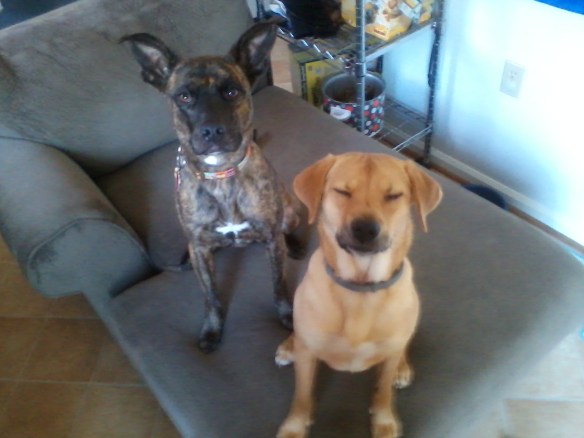
Lucy (left) and Poots (right) eagerly await the moment the humans stop fucking with the house
My wife and I watched the videos. We bought the materials. We cursed DIY as only people who don’t DIY can. We consulted friends. We got ready for the big day, Saturday, anticipating a day-long slog with probable work left over for Sunday.
And then my neighbor and his brother came over and relegated us to the Olympic Standing-There team (where we gave gold medal performances, by the way).
Two of the people who we consulted were our neighbors, nice folks who had done the same thing to their living room. We’re long-time friends (in essence, our neighbors are kinda our doppelgängers, if genders were reversed) and we asked if they could come over and help make sure we don’t do too badly.
And then, like I said, they kinda just did it for us. In, like, four hours. For people who kept saying, “We don’t have much experience”, they knocked that shit out, son, working efficiently at measuring, cutting, and laying (for those who haven’t partaken of this absolutely delightful experience, modern hardwood laminate is kinda like a jigsaw puzzle, especially to people who really hate jigsaw puzzles). Oh, my wife and I made sure the pattern continued (we had two different styles), but they made it seem stupidly easy.
And we really appreciated it. Like, totally. We don’t know what the fuck we’re doing, so having someone knowledgeable come along and say, “I’ll help you–just buy me a beer, okay?” is like manna from heaven.

The living room, now 75% completed and with 100% more Poots
We’re not done, yet, of course–I have to finish the doors to the end-tables, and we have to rehang the pictures, and my wife wants to do this thing with old drawers where you turn them into shelving–but the floor is done. The big job is done and I relearned the valuable lesson of having awesome-fuck-tastic neighbors.
I also learned the valuable lesson that DIY’ing things is bullshit. Yes, you made it yourself, but, by the end, you just wanna chuck the fucking thing into a wall.
So! To recap: neighbors are fucking awesome, DIY is fucking bullshit, and I’m slowly pulling my way through the stack of grading I’ve had to put off to get all this done (and with Christmas coming!). Whee!
_ _ _
Make me and yourself feel better and pick up Bones Are Made to be Broken in either trade paperback, eBook, or deluxe hardcover–Michael Bailey and I are working on the bonus material now on that last bit. You can also add Bones to your Goodreads Want to Read shelf here:

This is my living room as of Friday evening, December 2nd. We’re removing the carpet and putting down some sweet hardwood laminate. Oh yeah, baby.
…
Oh, you can fuck off with that notion.
Gather ’round, kids, and I’ll let you know, quickly, what’s up; about two years ago, my wife and I bought the house we’d been renting for two years (and the story about that is another thing entirely, but whatever). First time I’ve ever lived anywhere without a landlord (I’m a renter’s kid, through and through), and, for two years, my wife and I coasted, blue-skying what we’d like to do…eventually. When you’re renting, time for maintenance is more…fluid, for lack of a better term; you have a problem that’s not due to you being an asshole, you call the landlord. That’s why you have a goddamned security deposit, man.
But, when you own the place? Time is not fluid. It’s ticking, motherfucker, and getting louder with each passing second.
First, the sliding door leading onto the patio. Why the hell anyone would want a sliding glass door in the first place is beyond me. I’ve never seen one that isn’t, in some part, fucked up and broken and–well, whaddaya know!–so was mine.
Replace that.
Problems with the patio itself to the extent that your wife freaks every time you’re leaning against the railing while you smoke a cigarette?
Fix that (and thank fuck for your father-in-law who showed you how).
Quickly the jobs piled up. You learn on the go and plead to whatever god you happen to believe in at that moment that your savings account continues to exist afterwards. Our realtor, an awesome woman named Charlotte (who, for the majority of her time with us, saw me in trashed jeans or shorts and stained tee-shirts and was absolutely–pleasantly–shocked when I walked into her office in a suit one day after I got off work, something I find hysterical), pointed out that the first rule of ownership was maintenance and my wife and I took her seriously, but I don’t think either of us really absorbed the depth of what she meant.
Which brings me to the carpet.
When the previous owners bought the house, they had plans on flipping it; they’d done this before (but, apparently, weren’t paying attention to the headwinds; they bought the damn place at an inflated cost just as the housing market was cratering). Now, if you’ve never watched one of those house-flipping shows that my sister-in-law is obsessed with, what most people miss is that all the “changes” flippers do to a house is–largely–cosmetic. Any houses with serious structural or internal issues get a pass because it cuts into profit margin.
Cosmetic changes mean slapping a coat of renter’s paint–white, low-grade–on the walls that aren’t kitchen or bathroom; replacing any aged or stained carpet with new, clean, cheap, industrial grade carpet. And that’s what our landlords did–a full four years before my family walked into their lives.
Another two years, with pets and a growing toddler, and that carpet was showing some serious wear, to the point that my wife and I were embarrassed to have people in the house.
So, we DIY’ed that motherfucker.
Except, we couldn’t. Not at first.
First, we wanted to do the stairs leading to the 2nd floor, then the closet on the landing, and then we could do the carpet in the living room without all the other work fucking up the new floors.
So, my wife DIY’ed it, and got started…

Our 2nd dog, Poots, supervises.
…and my wife, mid-tearing up the carpet, goes into one of her rare (but always hysterical) rants about DIY because, here’s the thing: most DIY pages are run by people who do this as more than a hobby. They’re either flippers or extremely fucking motivated and aren’t just learning their way like the numbfucks who happen to click onto their site from a Google search. Now, to be fair, they usually say this in their About pages, but who the hell’s clicking on that when all a person wants are simple, idiot-proof directions?
So, a job that, according to the various DIY-sites, takes, like, two days, took us about two weeks:
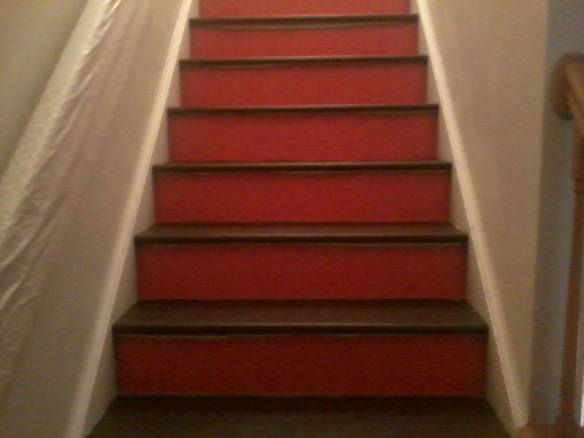
(To be fair: I deserve almost zero-credit for this; I pulled some staples and laid down some primer paint. My wife is a beast and I’m very much the hapless Igor that makes Marty Feldman in his iconic role look like Dr. Watson, if you’ll allow me to switch my references around.)
And now, nearly a month after we began, we’ve begun to work on the floor and I’m currently sitting on my red chair in the center of a room that either looks like the setting of a snuff-film or a house for hobos to frequent.
Oh, and we chose a laminate in the process of being discontinued. We’ve mixed and matched color-styles a bit, and we have no idea what we’re doing, and this is our weekend. Our dogs are confused. Our daughter’s enjoying the sound difference between the living room and the kitchen (which is crammed with our furniture).
I miss renting.
Oh, and this is costing us a fortune, so go order Bones Are Made to be Broken from either Amazon or Dark Regions Press.
Cheers. And (help).

So today, some awesome dropped into my lap, by way of Litreactor reviewer Keith Rawson, who did the Bookshots for Bones Are Made to be Broken. It’s not a gushing review, but it’s a solidly positive one, and when Rawson dings me, he dings me fairly–the novella maybe faring as a standalone book, which was (for those looking for some inside-baseball) something editor Michael Bailey and I discussed when I turned in the full manuscript at the beginning of the summer of 2016. The novella is a novella, in terms of length–though the first draft was very much a full-fledged novel (I, uh, overwrite)–but it’s an anchor for the book; if you don’t dig my stuff, it’s gonna be a drag, something to flip over, and there are a lot of pages to flip, y’know? Moreover, novellas as standalones are becoming more and more common (just take a look over at This Is Horror, which recently published Josh Malerman’s “The House at the Bottom of a Lake” and T.E. Grau’s “They Don’t Come Home Anymore”).
For about a week, it was a serious discussion, but I held forth that I wanted the novella as part of the collection–the collection was why I had written the novella instead of letting the idea simmer in my head, inspired by Pat R. Steiner’s art and the title combined together. Whether this turns out to be a good thing or a bad thing, that’s left for the reader to decide (he said, loftily). I can’t argue if someone says the novella should’ve been a standalone, even if I’m still happy with the decision I made.
In other news, Bones is now on Goodreads (so go add it as “Want to Read”, okay?) and that’s kinda cool. Completely irrelevant to anything else, it’s nice that, automatically, when a book is listed as Paul Michael Anderson, it gets added to me; before I began publishing by my full name, editors and publishers had to add something like twelve spaces between my first and last name for it to link to me directly (oh, the fun trivia of small-time publishing you learn by reading me, right?). Also, those who pre-ordered the book as eBook or trade paperback–or backed the Dark Regions Press campaign earlier this fall and picked Bones as a perk–are starting to get their books, which is also kinda cool, although weird when family members gush because my immediate thought is, “Wait until you read this before gushing.”
Michael Bailey, editor extraordinaire, pointed out that, along with my book popping onto shelves, Other Music by Marc Levinthal, and The Eighth by Stephanie M. Wytovich, was also released. I’ve only read a few pieces of Marc’s short fiction, but it’s left me intrigued at what he does with a full-length. Stephanie, however, is my sister from another mister. I’ve read oodles of her poetry, published her a few times when I’m in an editor’s chair somewhere, and I cannot wait to read this book. Click the link and tumble down the rabbit hole.
Finally, I’ve finally begun updating this site to accommodate the book release: you can now peruse the blurbs, details, some of the art on the Bones Are Made to be Broken page, and as reviews and interviews role in, you can check them out on the Press page (after I’m done gushing over them in a blog post, of course). Both are these are evolving as new info comes in (and I, uh, get better at doing this).
Now, this site is officially called “The Nothing-Space” and I like talking about my writing–uh, it’s why I have a site in the first place–but it’s not all I like to talk about. My problem has always been, though, that, by the time I articulate my thoughts on something–usually politics, sometimes music or pop culture–the initial oomph to write about it leaves me. It’s a change from my old journalism days, where my job was literally to write about whatever popped into my head (I once wrote a column about the music and organization of my funeral, for example). I kinda miss that. Might have to change that. We’ll see.
In the mean time, feel free to pick up Bones Are Made to be Broken here or here.
So. Tomorrow’s kinda a big day. Yep. A little bit.

Bones Are Made to be Broken will be released tomorrow, the 29th. I hope it does well. I mean, the people who blurbed it seemed to like it, and, since I last posted, another advance review came in, this time from Unnerving Magazine’s Eddie Generous, who wrote, “Gutting and deep-reaching, this collection dangles the dark side and delivers with such potency it’s difficult to imagine something better or more impactful. Strong writing blooms into something truly awesome with the emotion poured into these stories.” This on top of the stellar review from Thomas Joyce’s review over at This Is Horror just made me do a little happy dance (imagine a curmudgeonly, 6’2″ bearded sarcastic dude doing a little happy two-step–there you go).
Coming up, I talked a little bit with Becky Narron over at Roadie Notes and I show up, briefly, on the latest This Is Horror, to talk about creating suspenseful scenes–I, uh, hate the sound of my voice and if I sound like a tool, well…After that, more reviews will be coming in from places and people I respect and are my go-tos for good analysis even when it’s not my ass on the line (you know who you are, people). And then, well, people will see if the book sucks or not, won’t they?
So, yeah. Tomorrow. Big day. Mark ye olde calendars.
You can buy the paperback and eBook–and help me support my family; no pressure, though, over at the main publisher site, Dark Regions Press, and I’m seeing links for the eBook on Amazon. If you’re feeling special and fancy, you can spring for the deluxe, expanded, hardcover that editor Michael Bailey and I are currently fine-tuning.
Tomorrow.

Illustration by Pat R. Steiner, design by Michael Bailey

Well, the first review of Bones Are Made to be Broken is in and the verdict is…
“Every tale has one thing in common: Anderson’s ability to craft a compelling, thought-provoking, dark and beautifully heart-breaking story displaying the darkest depths of the human soul.”
– Thomas Joyce, This Is Horror
…really fucking good.
Oh, man, I needed that today. Joyce goes through the stories and gives a decent rundown on them; I find it funny that “Baby Grows a Conscience”, one of the oldest stories in the collection (it was originally published in 2011, written in the summer of 2010), gets such notice. Not funny in a bad way, and it’s not like the more recent stuff–the title novella, or “All That You Leave Behind”–doesn’t get some love, but my earliest stuff, even though written only a few years ago, feels so alien to me. When I decided to include it, I took it through a superficial rewrite–people who might have the original issue of Necrotic Tissue where “Baby” first appeared might notice the differences–but the initial read-through was like reading a story by someone else.
I’ve said this before, but it’s also my wife’s favorite story. And it has the distinction of me remembering exactly where I was when I wrote the opening line that Joyce singled out (“It was easier to hold a gun to a little girl’s head than Richie thought”)–during a break from conducting a writer’s workshop at a little convention. So, y’know, there you go.
You can read the review here. Also, pre-order the book–in either trade paperback, eBook, or super-snazzy-expanded-and-deluxe hardcover here.
Illustration by Pat R. Steiner, design by Michael Bailey
_ _ _
In other news…
What the ever-loving fuck just happened?
Tons of ink and bandwidth are being used to answer this question about the election. I have no answers–just railing, snarling, enraged snark that I won’t bother reciting here, leaving that to others. (Although I will say one thing–man, fuck my homestate of Pennsylvania. The running joke for years was that, between Pittsburgh and Philly was Alabama and this was the only thing either city could ever agree on. Who knew how fucking true that joke-that’s-not-a-joke was.)
No, I won’t put forth my own Monday-morning-quarterbacking because, right now, it all seems fucking pointless and out-of-place here. Besides, I’m a straight white dude; in the American game of life, I’m like a kid at a bowling alley who’s got the bumper-rails on the lane and one of those nifty-ass slides to push the bowling ball I’m too small to throw myself. This election, if all that was promised and threatened comes to fruition, would do more harm to those I love and cherish and respect than to me. And that fucking sucks, man.
Also, I have a daughter, five years old, and I was grooving on the idea that she was going to know that a woman president wasn’t just “possible”, but reality. I really, really liked the idea.
Now?
I only have this to hold on to, and I’m holding on to it like Rose in the movie Titanic (when she held onto the door, not Jack, because we all saw how holding onto Jack turned out–and, yes, I’m depressed that I know the names of these characters even though I haven’t seen the flick in 20 years):


Art by Luke Spooner
Adrian Shotbolt over at his review site Beavis the Bookhead has been running a writer’s version of VH1’s old show Storytellers (is that show still on? Jesus, if it doesn’t have a corporate mouse on its logo, I don’t watch much television, anymore). This past weekend, he’s been talking to the contributors of the Perpetual Motion Machine Publishing anthology Lost Signals (a really great book I’m more than a little proud to be a part of), and he spoke with me, Betty Rocksteady, and Michael Paul Gonzalez about our stories. You can check it out at the link, friendo (to cop a saying from friend Jessica McHugh).
_ _ _
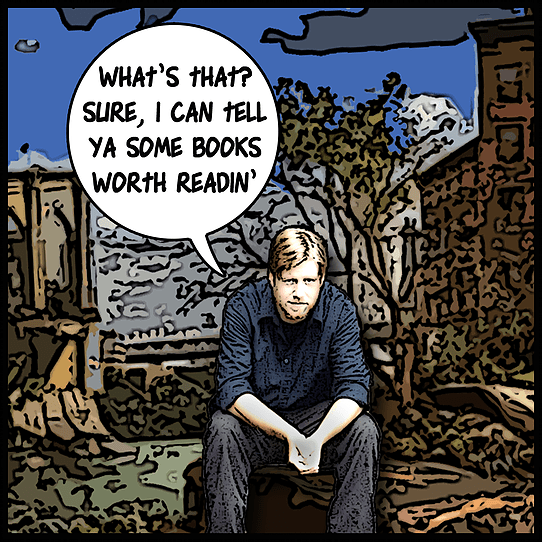
Last week, Eddie Generous over at Unnerving Magazine asked me for some book recs and I obliged because I love talking about good books–and not all of them horror. I take a kind of perverse pride in not sticking to my specific genre, if only because so many meatheads do stick, stubbornly, to only one genre.
That was probably the most startling thing I discovered when I dove into writing professionally/fandom/either-one-is-a-kind-of-Sisyphean-hell-so-terminology-is-up-for-grabs: you go to conventions or workshops and meet people who wouldn’t dream of stepping outside of their own imaginative neighborhood. SF fans who turn their noses up at horror, horror fans who think romance stops and starts at the covers of Danielle Steel novels, fiction fans who think nonfiction is confined to only boring textbooks from eleventh grade history class. All of them oblivious to the fact that, regardless of the mode, there’s a good story maybe waiting there–or, on a strictly self-interest level, turns of phrase or characterization or plot development they could learn from for their own work.
Meatheads. I hope I’m not one of them.
So, over at Unnerving you can read what books turn my dials up to eleven, but here are a few almost-rans, the books I almost gave in the article, if it pleases you:

In college, my history professor, noting my interest in late-19th century/early-20th century history as well as the centrist-progressive politics (is there such a thing? fuck it, sure) of my weekly column, recommended Theodore Rex, by Edmund Morris. I’d known of TR, of course, but like most kids in the latter days of the 20th, I knew more about his cousin, Franklin.
Reading the book, the second in a planned trilogy by Morris, was riveting, chronicling TR’s two terms in office, from tumultuous beginnings to placid end. I immediately went out and hunted down The Rise of Theodore Roosevelt, which won the Pulitzer and National Book Awards in 1980. This book, the first of the trilogy, detailed the beginnings of TR’s life. Morris’s writing is breathtaking–he takes library-sized-chunks of first and second-person accounts and manages to tell an actual story without dropping into the safe and dry-as-the-Mojave voice of a textbook.
He completed the trilogy, and the end of Roosevelt’s life, a few years ago with Colonel Roosevelt. I cannot recommend this trilogy enough, but start with The Rise of…first.
(Oh, and avoid H.W. Brand’s TR: The Last Romantic; it’s really, truly dogshit. Brand has a hardon for Woodrow Wilson, so everything else pales before the old Princeton president and cosplaying Lovecraft hobbyist [in both looks and views!]. To that end, Roosevelt gets pretty shoddy treatment. A nice supplement to Morris would probably be The Bully Pulpit by Doris Kearns Goodwin, which contrasts TR’s friendship with Taft and the rise of activist journalism.)
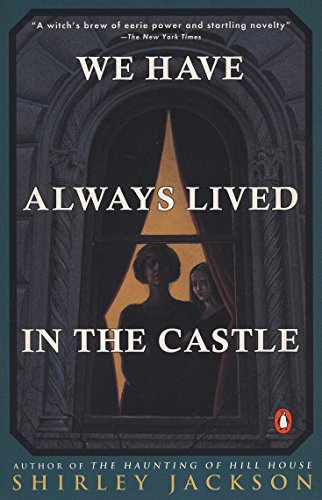
We Have Always Lived in the Castle, if you’re only a casual fan of Jackson (meaning, you know The Haunting of Hill House and–maybe–“The Lottery”), is unknown then, man, you need to discover this book. Tension pulls like a hangman’s rope and everything, everything, feels off and the almost orgiastic violence at the end feels like true catharsis. Read this fucking book. Like, now. I prefer Merricat to Eleanor.

In the 1980s, you were a fan of Rambo or Rocky. I went with the sullen, PTSD-afflicted Vietnam vet and it was only until years later, when I read the novel finally, that I figured out why I preferred the first movie to the second, where Stallone fully transformed this character into a stock-1980s action hero. Morrell’s character is the true anti-hero and there is no set good-guy-bad-guy here; Rambo and Teasle are perfectly matched in good and bad attributes and watching them bounce off each other is a treat of missed opportunities and retribution. In both the book and the film, the introduction of Trautman is almost a disappointment. I got a special-edition hardcover last year for my birthday, finally replacing the battered paperback pictured above.

If I’m funny at all (debatable), if I know anything about comic timing, it’s because I saw George Carlin’s 1991 special Jammin’ in New York when it premiered and when I was eight. Y’know, a wholly appropriate age to understand things like syphilis jokes and Desert Storm. Carlin once said that there are performers who wrote their own material, but he always thought of himself as a writer who performed his own material. The distinction is thin but not that hard to see. This is Carlin’s second book, after Brain Droppings and it’s basically a written version of his 1990s-era standup but thrown through his 1970s-goofball-nature.
_ _ _
This Is Horror‘s running their 6th Annual Awards and nominations are open for the month of November; my book’s not out yet, but that shouldn’t stop you because there’s been a glut of great books this year (and, hey, if you have read Bones Are Made to be Broken, maybe…?)
_ _ _
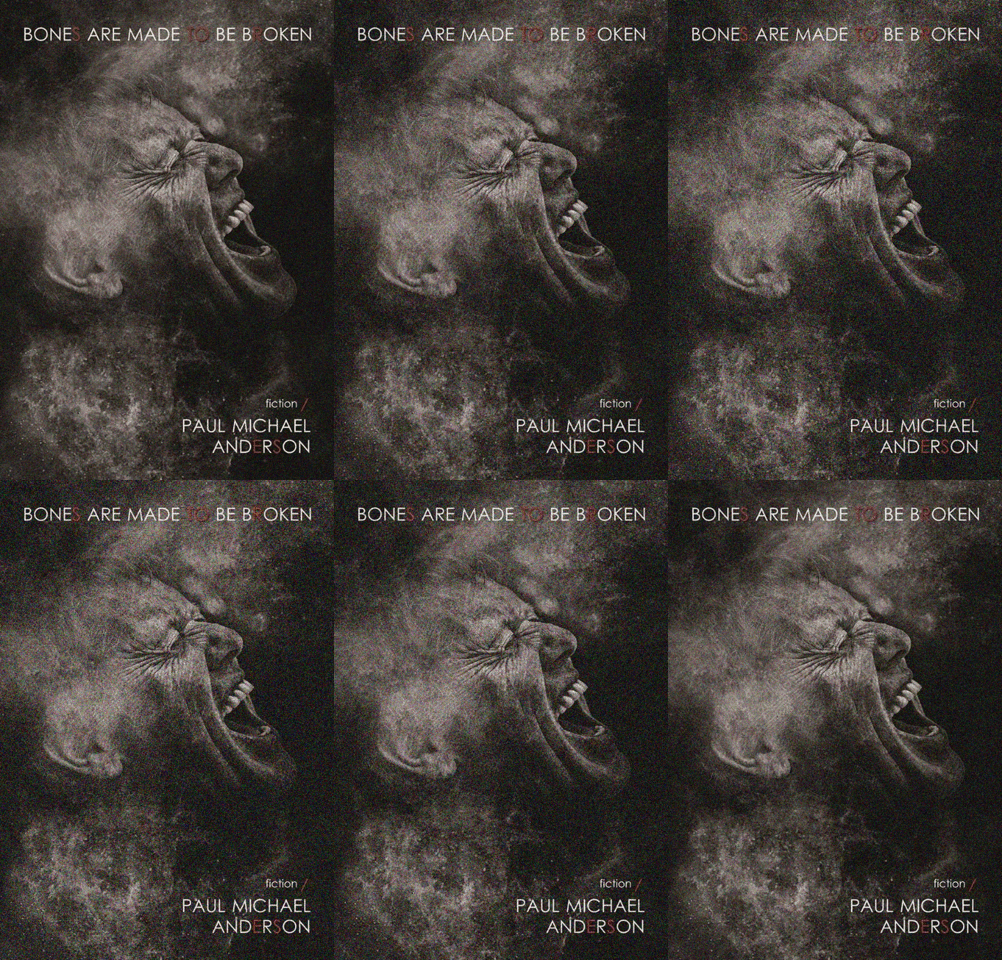
Also, finally settled because people who backed the earlier campaigns got first-dibs, Bones Are Made to be Broken will be hitting digital/physical (?) shelves on November 29th. You can pre-order here and, as I’m writing this on Election Night Eve (like a reverse Christmas where Santa kicks you in the balls), you can use the book for fire fuel after reading it–depending on who wins, of course, and I’m not talking about the Capable Queen of Pantsuits–so order lots, ‘kay? It’s gonna be a cold winter.
Stephanie M. Wytovich is my sister from another mister; another hometown Pennsylvania kid and, even better, a helluva writer. To top it all off, we both have books coming out from Dark Regions Press next month, her debut novel The Eighth and my debut collection Bones Are Made to be Broken, both up for pre-order right now.
A few weeks ago, Stephanie interviewed me over at her website, The Madhouse, and I wanted to open up the doors of The Nothing-Space. Whatever she wanted, provided it was awesome, and, in true Stephanie fashion, she brought the awesome.
So, I’m going to get out of her way, okay? See you at the other end and enjoy!
The Top 5 Paintings That Helped Me Write The Eighth
When I was an undergraduate at Seton Hill University, I majored in Art History in addition to my studies in English Literature, and while I’ve been blessed in having an absolute rock star writing mentor, I, too, had/have an exceptionally kick ass mentor in Art History, Maureen Vissat, who helped hone my skills as a historian to benefit my career as a horror writer (yeah, what’s up, liberal arts education?!). Maureen opened my eyes to the intricate world of surrealism, expressionism, and Dadaism and spoke with me at conferences about feminism and mainstream marketing. One of my favorite memories with us to date though is our trip to Italy where I studied Renaissance art in an intense two-week study abroad trip that took me to Rome, Florence, and Venice.
While I was in Rome, I got to see my first Francis Bacon panting—one of the screaming popes, no less—and in Venice, I stood amazed at the slew of surrealism and automatism that was stored in the Guggenheim from Dali to Carrington to Ernst. But even with a pit stop to see the Porcellino statue in Florence (see: Hannibal), and visits to the death (and almost-death) scenes of all of the cardinals in The DaVinci Code, the most memorable moment of the trip for me was seeing the house and gravesite of Dante Alighieri, the Italian poet whose vision of Hell in his work, The Inferno, inspired me to write the The Eighth in the first place.
But what happened after Italy, and after the nights spent cramming for tests on The Inferno and Milton’s Paradise Lost? The answer, of course, is more art! So take a moment and scope out the top five paintings that I studied to help build my version of the underworld and therefore shape the plot of my debut novel:

Not only did I fall in love with this painting for its celebration and punishment of the seven deadly sins, but I actually wrote a graphic novel about it in my Philosophy of Art I’m such a huge fan of Bosch, that I actually named one of my demons after him!

Piranesi’s claustrophobic and nightmarish prints highly influenced my decision to build the bridges in Hell as a chess game-like obstacle for my main character, Paimon, to overcome early on in the novel.

Frida Kahlo is one of my favorite painters, and her innate ability to inwardly reflect and sift through her trauma and demons not only relates to me on a personal level as a poet, but inspired how I dealt with Rhea’s character, particularly in the hospital scene where she wakes up and hears someone in the room with her.

In this iconic piece, Fuseli shows the dramatic and romantic portrayal of an incubus preying on a young female while she sleeps thus commenting on both the male gaze and the stereotype of the female as victim. This painting served as inspiration for the first time that Paimon sees Rhea in person in Caden’s bedroom.

One of my favorite paintings, and the print that hangs next to my writing desk at all times, Saturn Devouring His Son sets the mood and tone behind the concept of the Feeding Hall and the cannibalistic and necrophagic nature of the demons.
With flesh and blood,
Stephanie M. Wytovich
– –
Hey! Me, again. So, did that whet your appetite for The Eighth? (I’ve read Wytovich’s poetry, so I’m dying to read the novel; this recent review by Shane Douglas Keene over at This Is Horror just increases that need.) Check this out:
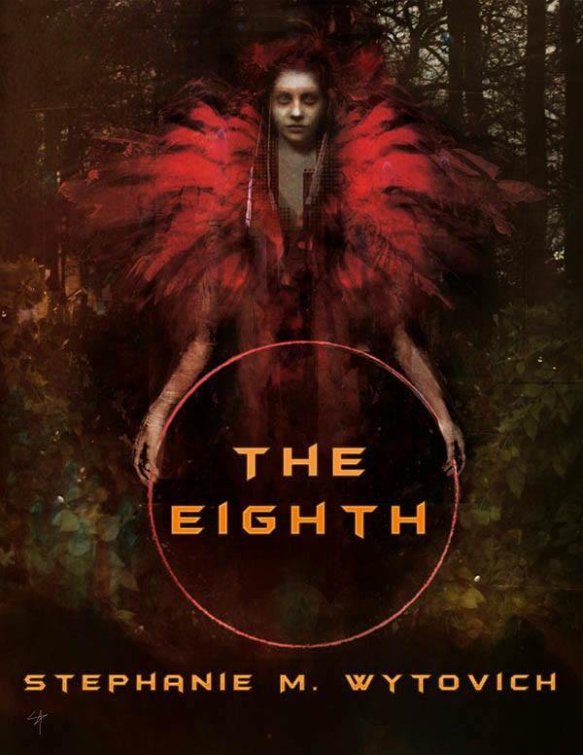
After Paimon, Lucifer’s top soul collector, falls in love with a mortal girl whose soul he is supposed to claim, he desperately tries everything in his power to save her from the Devil’s grasp. But what happens when a demon has to confront his demons, when he has to turn to something darker, something more sinister for help? Can Paimon survive the consequences of working with the Seven Deadly Sins-sins who have their own agenda with the Devil—or will he fall into a deeper, darker kind of hell?
Preorder here.

About Stephanie:
Stephanie M. Wytovich is an instructor by day and a horror writer by night. She is the Poetry Editor for Raw Dog Screaming Press, an adjunct at Western Connecticut State University, and a book reviewer for Nameless Magazine. She is a member of the Science Fiction Poetry Association, an active member of the Horror Writers Association, and a graduate of Seton Hill University’s MFA program for Writing Popular Fiction. Her Bram Stoker Award-nominated poetry collections, Hysteria: A Collection of Madness, Mourning Jewelry, An Exorcism of Angels, and Brothel can be found at Raw Dog Screaming Press, and her debut novel, The Eighth, is to be published through Dark Regions Press. Follow Wytovich at stephaniewytovich.com and on twitter @JustAfterSunset
 Paul Michael Anderson
