Unknown's avatar

About Paul Michael Anderson

Paul Michael Anderson is a writer, editor, journalist, and teacher living...somewhere

The Purpose of Blurbs

boneswithblurbs

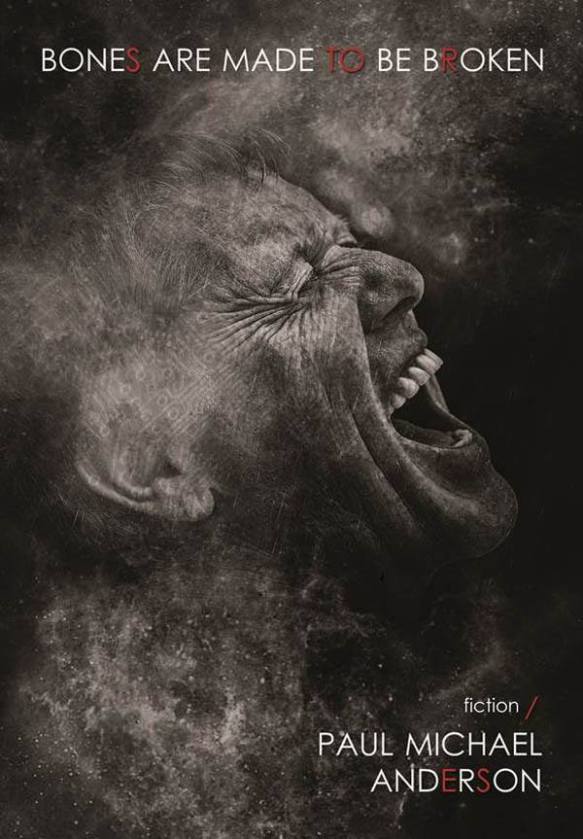
Illustration by Pat R. Steiner, design by Michael Bailey

When I was a kid, plucking novels from my mother’s bookshelf–first John Grisham, then Stephen King, then others–they were always paperbacks, almost all of them from the 1980s (this would’ve been the early to mid 1990s that the plucking occurred, you understand).

After reading the back cover copy, I’d open the front cover and always-always-always, there’d be blurbs.  From Publisher’s Weekly, and New York Times, and the Washington Post (being a Pittsburgh kid, I’d always grin to see the Post-Gazette and feel a little sad when it was only the Tribune Review).  All of them effusive in praise.  These would fill a page, sometimes two, sometimes longer (I think it was my mother’s crumbling copy of King’s IT that had four pages of blurbs), the first line in all-caps, all of the blurbs these punchy, active verbs of the awesomeness of the book I’m about to read.

It was from blurbs, and not journalism classes later, that I learned how to use ellipses, for example.

It was also from blurbs, when the following book failed to live up to the copy blasted on those browning front pages, the differences of perspective.  No, Los Angeles Times, this book wasn’t an EDGE-OF-YOUR-SEAT THRILL RIDE.

When the manuscript for Bones Are Made to be Broken was taking shape this past summer, my editor, Michael Bailey and I began to think of who to ask to read the book and, if they liked it, would be willing to write a blurb.  For me, I thought of those front pages of my mother’s old paperbacks–the pages yellowing, the edges soft and crumbly–and how effusive they were, and I got to work with Michael, e-mailing colleagues and people we respected, asking who’d be interested and, if interested, who would enjoy the book enough to have their name staked to it.

It was a weird experience but, then again, blurbs are weird themselves.  People always tell you to not judge a book by its cover but, let’s be honest–we do.  We do constantly.  I remember reading somewhere an editor saying that, in a book store, if you get a person to pick a book off the shelf, to look at it, to handle it, to maybe flip through the pages a little, you’re halfway to making a sale right there (hence, my constant sadness at the rise of online-only bookstores and the soft-death of brick-and-mortar).

But, how does that process start?  With a good cover.

And on that cover?  A good blurb.

But, again, blurbs are weird.  Everyone seems to agree that blurbs work–but no one knows how much, really, as mentioned in this article on NPR. Why do they work, though?  Even less is known about that and, with that question, you have the question of trusting what the blurb says…or, as I said earlier, the difference of perspective.

Over on YouTube, Harlan Ellison has a channel (and, yes, I also laughed at the idea of this) and on it are his old commentaries done from the early days of the SyFy Channel.  One commentary deals with the honesty of blurbs, and the ubiquitousness (made-up word?  Ah, go for it–or, when this happens in class, I say “English’d”) of certain blurbers.

Going back to those old paperbacks, a ton of them were blurbed by Stephen King–to the extent that his name, even blared from the top of the Dan Simmons novel Summer of Night, kinda just faded into the background, blending in with the Chicago Tribune or Boston Globe or New York Daily News.  It began to lose the weight that, maybe, everyone hoped for it.

And then there were those instances when I strongly disagreed with the blurbs, made worse when the blurb I disagreed with was King’s.  For example, I would grow to like Bentley Little’s work–some of it, anyway–but I fucking hated his novel University.  And who’s blurb was at the top of the cover?  King, saying, “Absolutely the best…a master of the macabre.”
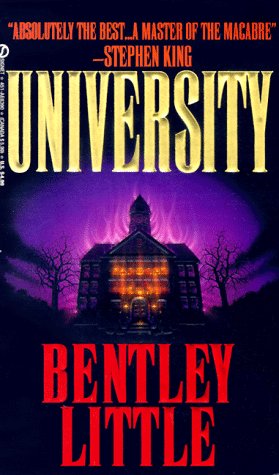
university

Ugh.

(Again, I’d grow to like Little’s other work, mostly his short stuff, and The Walking is an awesomely good novel, but some of his stuff?  Jesus Christ.)

But, on the other hand, when Stephen King not only blurbed Justin Cronin’s The Passage and then called in to Good Morning America when Cronin was on to give his endorsement on air, I snapped that hardcover up…and enjoyed the hell out of it.  I forgave him for the Bentley Little blurb.  (And, yes, I know it’s common practice to recycle blurbs, so that the blurb you’re reading may not be for the book your reading the blurb on…which is another problem altogether.)

All of which goes to say that blurbs are weird.  Sometimes they work, sometimes they don’t.  Sometimes they spark, sometimes they take off, but, hopefully at the very least they elicit a nod from someone who’s read a book and goes, “Yeah, that fits.”

So, anyway, over the past month, Michael and I have been fielding e-mails and messages from writers we/I respected, collecting the blurbs, geeking out and/or squee-ing when a particularly good one came through, and the quotes started to pile up.

It was weird, getting them.  I tend to take the Harlan route–blurbs are only given honestly and not out of some well-I’m-a-nice-person way, so when they started to come in, I breathed sighs of relief and got excited.  I mean, sure, 95% of the book contained stories that had already been sold, published, and appreciated, but those were one-offs.  Not to go too far down the neurotic rabbit hole, but what if a whole book of my stuff was a little bit…well, too much?  So, when blurbs started to come in, it was like getting early reviews and, thank Christ, the reviews were good.

So, for your edification, here’s what people are saying about Bones Are Made to be Broken, which will be out in mid-November, as well as my running commentary because god forbid I shut the fuck up for five minutes:

“In Bones Are Made to be Broken, the characters suffer and yearn as their beautifully wrought worlds shatter. Both universal and achingly personal, Anderson’s stories are moody, compelling, and drowning in wonder.” – Erinn Kemper

Like that?  Here’s another:

Bones Are Made to be Broken delivers chills, heartbreak, nail-biting suspense and horror. Paul Michael Anderson gives us a truly superb collection of deeply unnerving short stories.”–Jonathan Maberry, NY Times bestselling author of Patient Zero and Whistling Past the Graveyard

That one made my day.

“If your mantra is Bones Are Made to Be Broken, then you can expect suffering and guilt, death and destruction, dark destinies with little hope of survival. But in this powerful collection by Paul Michael Anderson there is also beauty and nostalgia, love and fulfillment, justice and heart. Nothing worth having ever comes easy, as these gothic narratives show us, in all of their horrifying glory.”—Richard Thomas, author of Breaker and Tribulations

You notice a theme beginning to emerge?

“Paul Michael Anderson writes like no other writer in dark fiction. His premises, plots, and story structure are unique. Every story in Bones Are Made to be Broken follows this pattern, and are intriguing and very good. Simply, he writes a Paul Michael Anderson story–the highest compliment any serious writer can hope to achieve. Highly recommended.” – Gene O’Neill, The Cal Wild Chronicles

I hope “a Paul Michael Anderson story” becomes a thing.

Bones Are Made to be Broken is a deftly told, beautifully written collection of horror and humanity. It’s obvious to me that Paul Michael Anderson has stared down the barrel of pain and come back to share these broken tales with us. This is a must-read collection.” – Mercedes M. Yardley, author of Pretty Little Dead Girls, Nameless, and Beautiful Sorrows

This one means a lot to me; I point out in the book’s introduction that I don’t write autobiography, but I pulled things from my own life–example: the apartment in the title novella was where my mother and I lived in 1991–to help me create a good sense of verisimilitude.  Also, Mercedes’s collection Beautiful Sorrows was fucking awesome.  Go buy it.

“Intense and emotionally crippling, Anderson’s stories are not for the faint of heart.” – Stephanie M. Wytovich, author of Brothel and The Eighth

Stephanie’s my sister from another mister; I had the honor of beta-reading and blurbing her last poetry collection, Brothel.

“What a pleasure to read these fresh and darksome tales! Anderson’s style is tensely exciting. His stories are never quite what you think they are going to be about and his endings resonate with fear. He gives us new horizons in horror that are futuristic and psychical. It’s hard to pick a favorite, but ‘Baby Grows a Conscience’ is simply brilliant! You’ll have to read them all. This collection is a treasure for any horror or dark SF fan’s library.”  –Marge Simon, Bram Stoker Award winner, VECTORS: A Week in the Death of a Planet

Trivia: Not my most-lauded, or most-recent piece, “Baby Grows a Conscience” is still my wife’s favorite story of mine.

“With notes of classic King, Anderson’s Bones Are Made To Be Brokenis filled with stories of the terrible things we see when we close our eyes. Anderson has a talent for rendering nightmares into words, and what he’s collected here are stories that creep inside and make a nest of your innards.” – Kristi DeMeester, author of Beneath

Both Kristi and I are parents, and reading this, I immediately thought of “All That You Leave Behind”, which deals heavily with that.

Bones Are Made to be Broken challenges the mind and punches the gut.” – Craig DiLouie, author of Suffer the Children

Craig’s quote has a nice bit of symmetry for me; it was on the strength of two blurbs on his novel, Suffer the Children, that pushed me over the edge to buying it.  My wife read it first, found it horrifying, and that made my need to read it a near-mania.  It was as gut-wrenching as my wife had said.  One of my students read it and then the book got passed around among my classes like contraband–“This is the book that terrified Anderson!” “Something terrified Anderson?” “Holy shit, dude!  this is messed up!”

The two blurbs?  They were by Jonathan Maberry and the guy below:

Bones Are Made to be Broken is a dark carnival of rigorous intelligence and compassion, the title novella alone of which is well worth the price of admission. But there’s not a weak sister in this generous bunch. These stories hurt the way only tough-minded character-driven stories can — the human element is never missing.  Anderson writes with a sure, steady hand, and I’ll be watching him closely from now on in.” – Jack Ketchum

Ads for Bones recently began playing on The Horror Show with Brian Keene, and Michael Bailey wrote copy that featured Ketchum’s quote.  On the first airing, Keene interjected about how good the blurb was.  Later, I got tweeted at by someone who’d heard the ad (I hope the dude also pre-ordered the book).

And that’s the goal–I hope–of good blurbs (and I got very, very blessed with some awesome blurbs by awesome writers): someone reads a blurb by someone they respect and they pick up the book.

I mean, hey, it worked for Craig DiLouie.

And, if any of those people above made Bones Are Made to be Broken seem interesting to you, you can pre-order the eBook/TPB or extra-fancy-expanded hardcover here.
 

Show Me Your TBRs

picture0921161828_1

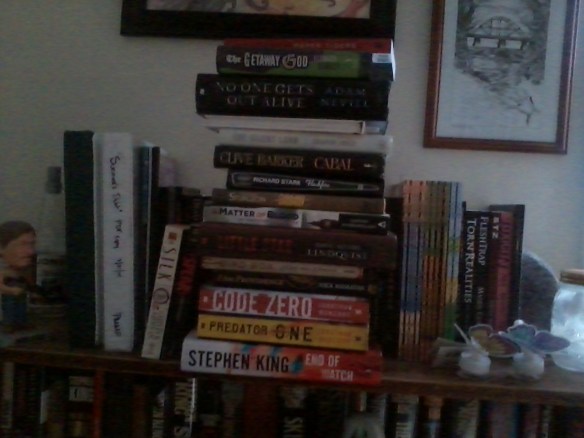
My current TBR (To-Be-Read, for whoever might not know that acronym) pile.  I’m quite happy with it.  Books I can’t help flip through whenever I pass this bookcase (the pile is currently covering a portion of my ego-shelf; hanging in the upper righthand corner is the illustration Glenn Chadbourne did for my story “The Agonizing Guilt of Relief (Last Days of a Ready-Made Victim)” in Chiral Mad 3).

I know a lot of people who buy and buy and buy books, piles of books, stacks of books, with the intention of reading them…eventually…but the idea makes me all spastic.  More power to those people, but I was once at a party at a house, and the walls were lined with crammed bookcases.  I asked the host about them and the guy shrugged–I can’t remember his name; he was a friend of a friend–saying that he hadn’t read most of them.  I wanted to scream.  Maybe I’ll never lose that aspect of renter’s mind, that facet of my personality that kicks in whenever I’ve moved (which is frequently over the course of thirty-three years), but if something’s taking up space, and I’m not using it or have no intention of using it, it’s got to go.  I…I just can’t.

So, I see these memes of book-buying addicts and I just go, “Yeah, not me.”  I have, typically, five bookcases filled.  If it gets to the point where I have more books than space–frequently–I go through and purge anything I’m not going to read again.  What people see is the distillation of frequent re-reads.  If I had more shelves, I’d have more books, but there you go.

Secondly, I have a kid, so if I’m picking up something for myself, I have to justify it hard to myself or else I feel guilt (most books I get, then, is due to ARCs and gifts from family) for not putting the money to the kid, or the house, or–hell–savings.

But, anyway, this TBR pile.  Again, I’m excited to dig in.  There’s not a book there where I either don’t already love the writer or the plot of the book.  If the picture sucks to you, this is what’s stacked there:

Paper Tigers – Damien Angelica Walters (re-read)

The Get-Away God – Richard Kadrey (kinda annoyed with this one; it’s the sixth book in the series and I’ve only read the first two, but when I see a hardcover Sandman Slim, I pick it up)

No One Gets Out Alive – Adam Nevill

The Minority Report – Philip K. Dick

The Silent Lands – Graham Joyce

Cabal – Clive Barker (re-read)

Flashfire – Richard Stark (re-read)

Godbody – Theodore Sturgeon

A Matter of Blood – Sarah Pinborough

Little Star – John Ajvide Linqvist

Bird Box – Josh Malerman

I Am Providence – Nick Mamatas

Code Zero – Jonathan Maberry

Predator One – Jonathan Maberry

End of Watch – Stephen King

Silk – Caitlin R. Kiernan

Spear – James Herbert (re-read)

Right now, I’m reading The Demolished Man by Alfred Bester.

But, what are you doing?

If you want to add a book to your own mammoth TBR-pile, may I suggest Bones Are Made to be Broken by, um, me?  It comes out in a month!

boneswithblurbs

Illustration by Pat R. Steiner, design by Michael Bailey

When You Ask Me How I Break My Bones

So I did a quickie interview with Stephanie M. Wytovich today.  As an aside, Stephanie said this about Bones Are Made to be Broken:

“Intense and emotionally crippling, Anderson’s stories are not for the faint of heart.”

Stephanie M. Wytovich, author of The Eighth & Brothel

(It was because of the second book mentioned that I almost titled this post “So a Brother Madam Asked Me How I Break My Bones”; I beta-read that collection, then blurbed it, because it was awesome.  Go check it out here. )

Both Stephanie and I are currently perks for Dark Regions Press’s IndieGogo campaign for special editions of three new anthologies–her with her first novel, The Eighth, and me with Bones–so we decided to chat with one another.  Stephanie should be dropping by here at some point within the next week.

For a quickie, it was fun; it’s pretty much a process interview and I can talk about that for hours (my interview with Joe Hill–you should, ahem, ignore the header image of Part One–back in June had to run in two parts due to length) because…well, fuck, it’s what I do, right?   Gimme questions like “What’s the hardest part of the writing process for you?” and I’m off, friends and neighbors.

You can peruse the interview here.  Also, afterwards, go here and pre-order our books (can I interest you in some trade-paperbacks and eBooks?  Or deluxe editions of same?)


Pre-ordering Bones Are Made to be Broken (a How-To)

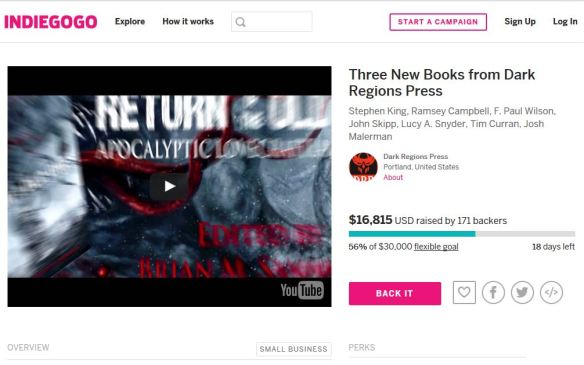
So, right now, my main publisher, Dark Regions Press (via Written Backwards) is running an Indiegogo campaign for three upcoming anthologies: Return of the Old Ones: Apocalyptic Lovecraftian Horrors; You, Human; and The Children of Gla’aki: A Tribute to Ramsey Campbell’s Great Old One.  My upcoming collection, Bones Are Made to be Broken, is a perk, along with Stephanie M. Wytovich’s first novel The Eighth (I’ve read her poetry and I can’t wait to see this, and Marc Levinthal’s Other Music.

It’s weird being part of a campaign.  I’ve never been, as they say (loftily).  Hell, I’ve never backed a campaign–not because I haven’t come across really awesome things in the past, but because, when you have a kid, any spare cash goes to him or her.

Because of this, the whole process has been an education for me–how it works, how it’s made, how it’s marketed.  I had to have my editor break it down for me over a series of days as to how it all works and the dude, the ever-reliable Michael Bailey (I’ve, uh, mentioned him a few times on here before), is still answering my periodic questions about the whole thing.

Don’t get me wrong, it’s nice.   People are seeing the book, backing the campaign, picking up the perks.  Michael calls this the “pre-pre-order” of Bones, which almost makes sense, but since I’m a kinda babe in the woods on this whole thing, doesn’t (I have a pre-order page, but it links to the Indiegogo campaign).

But, if you’re like me, it can be a little confusing if you’re looking for the perks only.  A few people over the past few days have told my wife or me (or both) that they’ve gotten hung up in the midst of pre-ordering my book (or they’re coming up with really bitching reasons to get out of buying the book, but I’m an optimist).  Because of this, here are the steps to get either my book, or Stephanie’s book, or Marc’s book (or, hell, splurge and get all three):


  1. On the Indiegogo page, you see the BACK IT button, but ignore that for now. Scroll down the page.indiegogopage
  2. On the right side of the page, you have a series of PERKS. You can pre-order my book from three of these: 

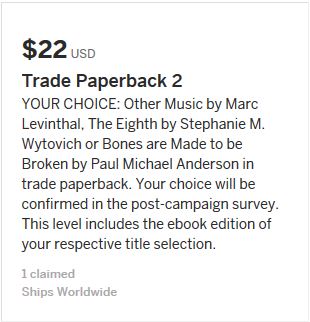
    a. If you select “Trade Paperback 2” ($22), you can select either my book BONES ARE MADE TO BE BROKEN, Stephanie M. Wytovich‘s THE EIGHTH, or Marc Levinthal‘s OTHER MUSIC in trade paperback/eBook. These are the pre-orders for those books, essentially.

    perk2

    b. If you select “BUNDLE – Paperbacks + eBooks 2”, you get ALL of the perk books, plus the three main anthologies (I have a story in one of them).bundleperk

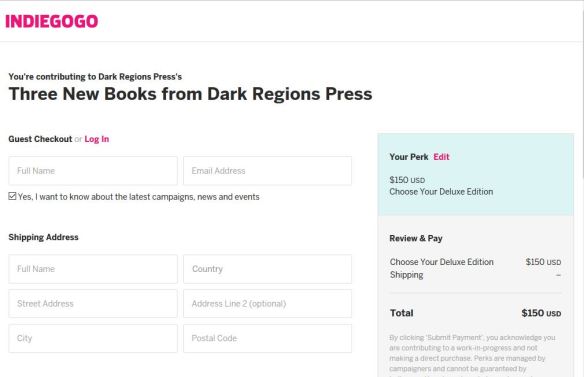
    c. If you select “Choose Your Deluxe 2”, you can pick up a signed, slipcase hardcover edition of the three perk books (again – me, or Stephanie, or Marc).chooseperk


  3. Pick one of those Perks and click it.


  4. You’ll be taken to the payment page, asking for name, mailing address, and billing information. Yes, it’s kinda counter-intuitive to give payment info before making your information. Took me a minute, too. Bear with me. Fill out that, and click “Submit Payment.”payment-page


  5. In a “post-campaign survey”, you’ll confirm which book you want (in my case, BONES ARE MADE TO BE BROKEN; in Steph’s case, THE EIGHTH; in Marc’s case OTHER MUSIC)
  6. That’s it. You’ve pre-ordered my book. Congrats. Thanks! Give me your money.

And, again, here’s that Indiegogo campaign link, ’cause I want it to do well.


Killing an urban legend (what did Hemingway say?)

In the recent published Lost Signals (Perpetual Motion Machine Publishing, edited by Max Booth III and Lori Michelle) and the upcoming Bones Are Made to be Broken (ahem), I have a story called “All That You Leave Behind”, which has the following epigraph:

unknownquote

Illustration by Luke Spooner; design by Max Booth III & Lori Michelle

Note the tag at the end of that quote.  Since I first sent that story in to my editors, I’ve been tagged with the inevitable question, “Wait–didn’t Hemingway say that?” at least six or seven times.

Unfortunately, no–Hemingway didn’t say that.

So we’re all on the same page: According (loosely) to legend, Ernest Hemingway was eating a meal with some other writers.  A bet was thrown down that none of the attending could write the shortest story possible.  Hemingway took his napkin, jotted those famous six words, and collected his winnings from the other participants.

It’s a great story, both the circumstances and the “story” itself.  When I want to convey  to my students the importance of word choice, and the effect good word choice can have, I’ll turn around and quickly write the six words on the board.  No comment, just action.  Then I turn back and wait.

First, there’s confusion–the kids (juniors, usually) are puzzling it out.

Then, around the ten-second mark, you get the first gasp as it clicks home. A few seconds later, another gasp.  Then, a rattle of them.  Eventually, all 20-some students have gotten the point.  Then they all begin talking at once, over each other, reacting to it.

That’s some good goddamn writing.

But Hemingway didn’t write it.

The best distillation of this legend–and the truth behind it–can be found in this article from OpenCulture.  The salient points are: variations of the six-word story can be found in newspaper ads going back to the turn of the 20th century and, when noticed, caught fire.  Hemingway might have been aware of it–he’d worked as a reporter, after all–but the details of the incident I summarized above appear nowhere a literary agent made an anecdote out of it in 1974, then republished it in a writing manual in 1991.

Since then, it’s been referenced by titans of the field and used in either a Broadway show or off-Broadway show (I forget which) about Poppa.

If enough people repeat a legend over and over and over again, does that make it true?

When writing “All That You Leave Behind”–which, oddly enough, is one of my more positive stories–I knew I was going to use the epigraph at the top of the story–something I’d never done before (though, in Bones Are Made to be Broken, I used an epigraph in the title novella, too, and “Behind” follows that immediately).  But, do I attribute it to Hemingway or the “true” (read: unknown) author?  This was something I seriously debated with myself (yes, my day-to-day thoughts are kinda dull).

In the end, it was my own training as a newspaperman that made me go “Unknown Author”.  No one can confirm whether it was Hemingway or not–Snopes lists the urban legend unequivocally as “false”–and so I went with that.

It’s not a stake through an urban legend’s heart, nor that groundbreaking of investigation (do five-second Google searches count?), but there you go.

Oh, and make sure you order Lost Signals (it’s damn good, even discounting my own, ahem, brilliant part) and pre-order Bones Are Made to be Broken (select either “Trade Paperback 2”, “BUNDLE – Paperbacks + eBooks 2”, or “Choose Your Deluxe Edition”…Poppa needs some royalties).

boneswithblurbs

Illustration by Pat R. Steiner, design by Michael Bailey (also, yes, Jack Ketchum blurbed me, as well as a host of other awesome people; that’s a story for another day)

lost-signals-jacket

Jacket image by Matthew Revert


Bones Are Made to be Broken is up for pre-order

So go buy it already.  What are you waiting for?

Today, it was officially announced, via newsletter and social media blasts that a lot of people seem to be “like”-ing, that my first book, Bones Are Made to be Broken is up for pre-order over at Dark Regions Press’s current campaign for the anthologies Return of the Old Ones: Apocalyptic Lovecraftian Fiction, The Children of Gla’aki: A Tribute to Ramsey Campbell’s Great Old One, and You, Human.  The paperback will be released, officially, on October 18, 2016, the day before my wife’s birthday (and picked because of that, actually).

I’m just going to simplify the whole thing: Go here to pick up the paperback/eBook (it’s set at $22.00) and here to pick up the deluxe, slipcased hardcover (it’s set at $150.00).  You have options, then; once you make your…donation? contribution? sacrifice to the ink-blood demon?..you select the book you want–in this case, Bones Are Made to be Broken.  Go now.  I’ll wait.

giphy

Oh, so now you’re waiting yourself, are you?  Perhaps wondering what’s in the book?  Weighing whether it’s worth some of that hard-earned cash of yours?

Okay, then.

Well, first, the book collects 14 pieces from the past 5 years (15 pieces in the hardcover–I’ll explain).  2 of the pieces are original to the collection, including the title story, a 38,000 novella I wrote specifically for the book.  The other piece was supposed to be published–in 2012, I think–but the project fell through after the story was sold.  All stories are illustrated by Pat R. Steiner, who also designed the glorious masthead for my website (for which I’m eternally grateful), not to mention the cover(s).

Oh, and Damien Angelica Walters, writer of hands-down my favorite novel of the year (Paper Tigers) is writing the foreword.  So, y’know, that’s a thing that’s happening.

As for the meat of the book, with two different editions come two different versions–not just with material but also the cover.  When it comes to the paperback, you’ll be getting this:

14141557_10157325638805223_6362829419929938004_n

  1. Foreword – Damien Angelica Walters
  2. Introduction – Where You Find Yourself When You’re Nowhere
  3. “Crawling Back to You”
  4. “Survivor’s Debt”
  5. “Baby Grows a Conscience”
  6. “A Nice Town with Very Clean Streets”
  7. “The Doorway Man”
  8. “Love Song for the Rejected”
  9. “The Universe Is Dying”
  10. “Surviving the River Styx”
  11. “The Agonizing Guilt of Relief (Last Days of a Ready-Made Victim)”
  12. “Reflecting the Heart’s Desire” **
  13. “To Touch the Dead”
  14. “In the Nothing-Space, I Am What You Made Me”
  15. “Bones Are Made to be Broken” **
  16. “All That You Leave Behind”
  17. Acknowledgements

** – never-before-released

The book, in paperback/eBook, is a mighty tome, but the hardcover’s got more weight to it.  When editor Michael Bailey and I were discussing the book, I wanted to make sure any limited edition had as much bang for the buck as possible.  Yes, Dark Regions produces some wonderful hardcover editions, truly beautiful, but what’s between those oh-so-sexy covers has to match up, right?

So, in the end, all the illustrations will be rendered in glorious color, and we added roughly an additional 19,000 words of bonus material for your eyeballs to go with all that color.  Also, a cover you might be familiar with if you follow me, or Michael Bailey, or Pat R. Steiner (designer extraordinaire), or Written Backwards on social media:

Pageflex Persona [document: PRS0000038_00074]

  1. Foreword – Damien Angelica Walters
  2. Introduction – Where You Find Yourself When You’re Nowhere
  3. “Crawling Back to You”
    1. Notes
  4. “Survivor’s Debt”
    1. Notes
  5. “Baby Grows a Conscience”
    1. Notes
  6. “A Nice Town with Very Clean Streets”
    1. Notes
  7. “The Doorway Man”
    1. Notes
  8. “Love Song for the Rejected”
    1. Notes
  9. “The Universe Is Dying”
    1. Notes
  10. “Grownups”
    1. Notes
  11. “Surviving the River Styx”
    1. Notes
  12. “The Agonizing Guilt of Relief (Last Days of a Ready-Made Victim)”
    1. Notes
  13. “Reflecting the Heart’s Desire” **
    1. Notes
  14. “To Touch the Dead”
    1. Notes
  15. “In the Nothing-Space, I Am What You Made Me”
    1. Notes
  16. “Bones Are Made to be Broken” **
    1. Notes
  17. “All That You Leave Behind”
    1. Notes
  18. Acknowledgements

** – never-before-released

Like I said, a little meatier.

I have to say a few words about two things before I get to the ego-stroking of awesome people saying nice things about me: first about Pat R. Steiner and, second, about Perpetual Motion Machine Publishing.

First, Pat fucking outdid himself on these illustrations.  Some have trickled out onto the interwebs, like this one:

the-universe_bw2_edited-2

“The Universe Is Dying” (Pat R. Steiner) – also, you have to see this thing in goddamn color.

However, I cannot wait until the others see the light of day. Right now, my favorites are the illustrations for “Survivor’s Debt” and “Baby Grows a Conscience.”  Sweet goddamn Jee-zus, they’re good.  However, my favorites switch roughly weekly at this point.

On Perpetual Motion Machine Publishing – The last story in the collection is “All That You Leave Behind”, which was just published in the anthology Lost Signals, edited by Max Booth III and Lori Michelle.  And I mean, just.  My initial story-lists didn’t include the story because it was so new and, as anyone in the business knows, typically there’s a bit of a wait a writer’s gotta do between original publication and reprint.  However, I fucking loved the story, Michael fucking loved the story, and I thought it would’ve been the perfect capstone to my collection (especially coming after the title-novella; just wait, you’ll see).

So, I talked to Max and, thank Christ, he was on-board and cool.  “Actually,” he told me, “I was hoping you’d put it in your book.”

It’s easy to vilify small press–there are enough charlatans out there to populate a mid-sized European country–but when there’s a good one doing good work, you need to recognize.  PMMP does great work.

(I glorify PMMP and another press, Grey Matter Press, in the book’s acknowledgements, but–y’know, spread the good word and all that.  Also, go pick up Lost Signals.)

Finally, blurbs are starting to trickle in; two of which that are publicly available right now–because Dark Regions published them–come from two Bram Stoker Award winners:

“Anderson’s style is tensely exciting. This collection is a treasure for any horror or dark SF fan’s library.” – Marge Simon

“Paul Michael Anderson writes like no other writer in dark fiction. Simply, he writes a Paul Michael Anderson story—the highest compliment any serious writer can hope to achieve.” – Gene O’Neill

There are others, and goddamn are they nice, but that’ll do for now.  Also, it’s two a.m. and I’m tired.

So, I’ll close with a final shout-out to Justin Courtney Pierre, lead singer of the band Motion City Soundtrack.  He did a song by himself recently, “Everything That Hurts,” and I fell in love with it.  As I was rewriting “Bones”, I put the chorus at the top of page 1 as an epigraph, to get to the heart of what I was trying to write in the story itself.  When the book began to inch towards publication, I went, “What the hell” and asked Justin if I could use the chorus.  And he said, “Yes.”

Check out the song below and, if you like it, go to his linked page and pick it up.  It’ll cost you the princely sum of $1, but it’s worth way more.

(Also, thanks, Justin.)

Now, go pre-order Bones Are Made to be Broken.

Lost Signals coming through the wire

So, this dropped this week:

lost-signals-jacket

Jacket image by Matthew Revert

You can pick up the anthology here, as well as read Max Booth III’s origins for the anthology here.

The names are impressive and I was given a quick peek inside the full book before it dropped and, hoo boy, it’s stunning.

But, fuck that, this is about me, right?  Right.

(Although, honestly, the other stories are pretty goddamned brilliant.  Anyway.)

AllThatYouLeaveBehind-Spooner

Story illustration by Luke Spooner

For this, I’m going to dip into the story notes for “All That You Leave Behind”, lifted–but modified–from the deluxe hardcover edition of my upcoming collection Bones Are Made to be Broken:

…So.

Here’s “All That You Leave Behind”.

…I can never describe the depth of the emotions that go through you in the middle of a pregnancy–although, if parents are reading this, you probably know. It’s the world’s worst, most abstract waiting room, when you’re stuck anticipating the moment the doctor comes in with the results of the biopsy report.  Even if every checkup and ultrasound come back clean, you still worry.  You still fear, but the articulation of that fear is nearly impossible to get across in any way that feels true to you.  The truest things in life are the hardest things to express.

There’s nothing more terrifying than parenting.  Nothing.  The constant realizing—and, thus, terror—that you are responsible for another life, a life that had no say in its creation and existence, a life that looks to you to navigate the ship, can freeze you in your tracks. 

But what if you’d geared yourself up for dealing with that fear and realization, only to have it taken away from you?

I was reading Lauren Beukes’s stellar Broken Monsters and there’s a throwaway line in it about a ghost heartbeat.  When I heard about Max and Lori’s upcoming anthology and its general theme of white noise, that line recurred to me, and the structure of the story was born.  It was fueled by the fears every expecting parent has when they walk in for the monthly check-up or ultrasound.  I asked myself the terrible what-if: What if my daughter had been a miscarriage? What if my wife and I had to come to terms with that?

And I wrote my answer to those questions.  It…it wasn’t easy.  At one point in the first draft, I pulled the little DVD the ultrasound tech gave us, and watched my daughter in utero over and over and over again, and I burst into tears.  Just a small clip, under a minute long, but I sat at my kitchen table, my usual writing place, bawling my eyes out late at night with my daughter–completely fine and five years old and asleep with her ragged Bear-Bear–right above my head.  

Parenting is terrifying and the fears–even the stupid, irrational fears–never, ever leave you.

In the end, I made it a half-assed homage to Jack Finney, much in the same way that Joe Hill’s “The Black Phone” in 20th Century Ghosts.  Note the characters’ surnames.  Also, the story takes place in Galesburg, Illinois, a setting that creeps up with Finney (and Hill’s story).  Mostly, though, it’s tone.  Every writer can be fairly panting—the unfortunate side-effect of wanting to make sure we’re touching the reader—but Finney was the best; he set you up, you knocked you down, but he never had to lead you by the nose. 

Finney was pretty neat that way. For me, it was a way to separate myself when the going got tough between my would-be mother and father.

A final note on this story: My wife has not read it.  She’s my go-to for draft readings—she once read something like eight drafts of a story—but she couldn’t, she said, because of the subject matter.  I understood, of course, even if the writing of the story wound up being cathartic for me, a place to shove all the negative worst-case scenarios that, even five years after my daughter was born healthy and alive, still rested in the back of my head (and, if I’m being fully honest, still do).  Because of timing with the deadline–the story, uh, ran a bit long–I went to only one other beta-reader.

She got back to me rather quickly, calling me a bastard and saying I’d made her cry in a Starbucks while she read it.  That’s the plan, man.  Horror is supposed to make you fearful, terrify you, but first it has to make you feel.  You have to empathize.  Done to the hilt, you get the tears—or the laughter—as well as the screams.

In the early reviews, the story kept getting mentioned in a positive way.  Christine Morgan, for example, called it “beautiful tragic emotional agony”.  I’m proud of the story, which shouldn’t be all that surprising, and happy that Max and Lori bought it (and, further, cool with the idea of me reprinting it in Bones; they get some big love in my acknowledgements).

I hope you like it, too.  Hell, I hope I make you cry in a Starbucks (sorry, Erinn).

Here’s a song I find beautiful

So, part of this thing below –

12814494_10100648602847075_6876809168953399886_n

Pulled from Facebook. Stop looking at me like that.

Day 2 is “a song you find incredibly beautiful.”  Yesterday was song played at your funeral–that would be “Happy Anniversary” by Motion City Soundtrack–and today’s song was immediate in my head: the cover of “Stand By Me” Tracy Chapman did on The Late Show with David Letterman.  Peep it below:

I heard the original when I was five or so, when I first saw the Rob Reiner film/Stephen King adaptation Stand by Me (which led to a later love of Buddy Holly, but whatever) and loved it ever since; I still have the cassette soundtrack to the film, even though I haven’t had a tape player of any kind in fifteen years.

I heard this version of “Stand By Me” about a year ago, and it basically completely changed my previous assumption that no one could do that song better (John Lennon covered it in the 1970s, but like everything John Lennon did solo, I thought it was fucking terrible).  Tracy Chapman, who I haven’t thought of since 1996, when “Give Me One Reason” was inescapable, totally owned this song.  It reminds me of when Cash covered Nine Inch Nails’s “Hurt” and made that song his to such an extent that Trent Reznor said in an interview with Alternative Press that the song wasn’t a NIN tune anymore.

So, anyway, there you go. Day 2 and some beauty.

Tomorrow?  A song that would make people think of me and I have no fucking idea what that would be.  (Sidenote: Reviewing the list, goddamn some of them are cheesy–a song that empowers me? Da fuque?–but I’ll figure it out.)

In other news, illustrations are coming in for Bones Are Made to be Broken and they take my breath away.  Some blurbs are coming in and they leave me going, “Wait? Are they talking about me?” I’m thinking, sometime this month, I’ll do a breakdown of everything coming down the line, which I realize I haven’t done yet.  Gotta remedy that.

Just not today, ’cause I’m tired.

1786023

John Rambo thinks that’s a great idea

Oh, hi there…

Subtitled “Random Things I’ve Done Over the Course of the Past Two Months”

Instead of writing tonight–I, uh, have deadlines staring at me–I chose to hang out with my wife and watch Primary Colors for the first time in a few years.  I just reread the book–a shiny hardcover I picked up at a thrift store, recently–and I love it so very much, if only for its odd balance of optimism and cynicism.

Also, it’s incredibly quotable during election years.  Example:

“This is the price you pay to lead.”

Not coincidentally, this was watched the day after Hillary Clinton was nominated as the Democratic candidate for President.  This is a historical election; the first woman nominee of a major political party (oh, and fuck off with the, “But there were women who were nominees for third parties…” stuff), as well–on the Republican side–the first sentient Internet Comment Wall.  Historical stuff, indeed.

On the personal front…well, lemme just paste a snip from my private Facebook page; it’ll say it more concisely than I will at 1:37 in the goddamned morning:

Simplify bitches

So…that’s what I’ve been doing, writing-wise.  For the past few weeks, bupkis.  It’s bugging me, but I also have the thinking patterns right now of a sleeping tree sloth, so there’s that.  I have three stories at various points–including the one mentioned above–of progress, and wanna write at least one more before I become Teacher Man for another school year.

On the Bones Are Made to be Broken front, my editor, Michael Bailey, is going like a house a-fire, and we’re in heavy prep and setup now.  I feel like Cheeto Jesus himself by saying there’s so much awesome coming, but not telling you what the awesome is, but it’s true.  Here’s what I will/can say:

  1. The trade paperback and hardcover will be substantially different, with all kinds of goodies in the HC to make it that much more special, totaling over 10,000 additional words from the paperback/eBook.
  2. Justin Pierre (of Motion City Soundtrack) is the fucking man.
  3. We have an illustrator, and I’ve seen samples, and OH MY FUCKING GOD.
  4. We have someone writing the introduction, and OH MY FUCKING GOD.
  5. In the next week, ARCs will be going out to people who’ve agreed to do blurbs (already got one and OH MY FUCKING GOD).  Reviewers, take note, please.
  6. There are…things?  Things…happening in August.
  7. October’s looking like a month you want to pay attention to.

I might be able to say more, might not, but it’s late.  More to come on that one.

Finally, though, there’s this:

12814494_10100648602847075_6876809168953399886_n

Pulled from Facebook. Stop looking at me like that.

I’m a music hound; not as much of a voracious listener as I was in my teens and twenties, but I still find new bands to love.  Anyway, I saw this thing and thought, “What the fuck.”

Here’s Day 1: A Song You Would Like Your Loved Ones to Play at Your Funeral –

This song can make me cry (problematic when driving, which is–when I’m not writing–where I do the most music-listenin’).  It’s told from the perspective of someone dying, if that’s not completely obvious from the lyrics themselves.  These are the things, particularly the chorus, that I would want to say to my loved ones when I die, which I’ve decided will be November 21, 2063, the 56th wedding anniversary to my wife.  I’d be 80.  That’s a good run, right?

Tomorrow, somethin’ beautiful.

The Agonizing Relief of Publication (Last Days of a Story Release)

So, tomorrow (that’s April 5th, a Tuesday, and…y’know…the standard release day for new books), Chiral Mad 3 will be released into the wild in paperback, eBook, and deluxe hardcover.   Editor Michael Bailey has a write-up here at the Written Backwards site.

chiralmad3

The Table of Contents is a Who’s Who of Awesome.

Introduction: Observations on Horror Burnout – Chuck Palahniuk

Fiction:
01. The Poetry of Life – Richard Chizmar
02. The Last Rung on the Ladder – Stephen King
03. A Rift in Reflection – Hal Bodner
04. Windows, Mirrors, Doors – Jason V Brock
05. Prayer – Mort Castle
06. The Agonizing Guilt of Relief (Last Days of a Ready-Made Victim) – Paul Michael Anderson
07. The Black Crow of Boddinstraße – Emily Cataneo
08. A Flash of Red – Erinn Kemper
09. Red Runner vs. The Surgeon, Issue 18 – Jessica May Lin
10. The Dead Collection – Mercedes Murdock Yardley
11. Watch Me – Meghan Arcuri-Moran
12. The Bigger Bedroom – Josh Malerman
13. That Perilous Stuff – Scott Edelman
14. Know Your Code – Ramsey Campbell
15. 3-Dot People – Gene O’Neill
16. Silver Thread, Hammer Ring – Gary A. Braunbeck
17. Those Who Watch From on High – Eric J. Guignard
18. Blood Dust – Max Booth III
19. The Offering on the Hill – Richard Thomas
20. The Whipping Girls – Damien Angelica Walters
21. Seconds – Jack Ketchum

Poetry:
01. Fair – P. Gardner Goldsmith
02. Fail-Safe – Jonathan Balog
03. Folie à Deux – Sydney Leigh
04. Reflecting on Reflections – Bruce Boston
05. Mirror Image – Marge Simon
06. Black River #1 – Elizabeth Massie
07. Prescience – Rose Blackthorn
08. The Speed of Sound – Ciarán Parkes
09. Welcome Home, Darling – Stephanie M. Wytovich
10. Whisper #1 (A Warning) – Erik T. Johnson
11. Whisper #2 (A Prophecy) – Erik T. Johnson
12. Put Me to Dream – Stephanie M. Wytovich
13. Recognizing Trees – Ciarán Parkes
14. Arbitration – Rose Blackthorn
15. Black River #2 – Elizabeth Massie
16. Reflections Through the Raven’s Eye – Marge Simon
17. Beyond Symmetry – Bruce Boston
18. Folie à Plusieurs – Sydney Leigh
19. Insomnia in Reverse – Jonathan Balog
20. Promise – P. Gardner Goldsmith

But, right now, this is all about me, baby, and I’m up there, with my mouthful of a title, “The Agonizing Guilt of Relief (Last Days of a Ready-Made Victim)” and I just have one thing to say:

I hope you enjoy it.

The story was, initially, the meat of another story that, to this day, still hasn’t been written to my liking (although I still have the opening line burned into my head: “We, the dead children, came out of the forest and gathered around the fire of memory”).  I wrote a draft, called “And You Will Hear the Dead Sing”, and gave it both to my wife and to the writer Damien Angelica Walters–author of Paper Tigers, so-far my favorite book of 2016–for a beta-read.

They both gave the story back a few days later and said the same thing: The frame-story was meh–good idea, but not any great shakes–but the core story was something I needed to take another look at.  There’s something, yknow, there.

And so I did.

And the implications terrified me.

I’m not necessary a monster-writer; to me, the most terrifying things in the world, or out of this world, are the things inside our heads.  Even when there’s a monster of a kind (Like in “In the Nothing-Space, I Am What You Made Me” or “A Nice Town with Very Clean Streets”) in the story, to me, the most interesting and horrifying aspects are what the people do or are driven to do.  However, I’ve used shades of the supernatural in every single piece I’ve published to-date.

But, with the core story, there was nothing supernatural.  It was just these two brothers and their single father.  Not a monster of any kind.

Jesus Christ, it was a, dare I say it, a literary piece.

I want to say, now, that I hemmed and hawed, that I agonized over the story and the work I would have to put in.  But, honestly, I jumped at the chance because, really, while the idea that it was just these three characters and what happens over the course of one week in December of 1996 (a time period that factors into another piece, called “The Universe Is Dying”, but I’ll get to that later), I saw something, a sparkle, that was so much cooler than any ghost or elder god or monster.

Here was a chance to put what terrified me most–what, to me, is the core of all horror–into the front seat of a story.  To let it drive it instead of adding verisimilitude from the passenger seat.  I got to focus on the mind.

At the time, it was the darkest story I had ever written, with the darkest ending.  There was no ambiguity with this one, no grinning crypt keeper smirk from the sidelines.  I put the horror front and center and forced everyone, including myself, to look at it.

In the story of our lives, we all want to be the heroes, believe we are the heroes, but there are always those times when we can’t be; we’re not even the villains, we’re just…helpless.  We want to do the right thing, we strive and kill ourselves over it, and when the decision’s taken out of our hands, what we feel is…relief.  Horrific relief.  The hero image we hold up as a reflection of what we think we are shatters.

I never could’ve written that story if it’d included the original frame, as awesome as that opening line is.

But, without it, I was able to write “The Agonizing Guilt of Relief (Last Days of a Ready-Made Victim)”, which made another beta-reader go “Jesus Christ” when he got to the end (I think that’s good), and, when Michael Bailey saw it, snapped it right up for Chiral Mad 3.

From there, it opened me up massively.  It became the beginning piece of a (unintentional) mourning triptych that continued into “All That You Leave Behind” (appearing this summer in Perpetual Motion Machine’s Lost Signals anthology) and “The Universe Is Dying” (in the upcoming You, Human anthology).  All three stories deal with loss on some form and, beyond “Agonizing Guilt” and “Universe” sharing the same relative time frame of the end of 1996, unconnected.  “Agonizing Guilt” is the darkest piece.

[ahem, all three of those stories, along with the new reigning champion of the darkest thing I’ve ever written will be appearing together, possibly.  Ahem.]

I hope you like it.

And, if you do like it, talk it up, will ya?  Reviews, social media posts, that sort of thing.

[insert pre-order thing here, when pre-ordering becomes a thing.]